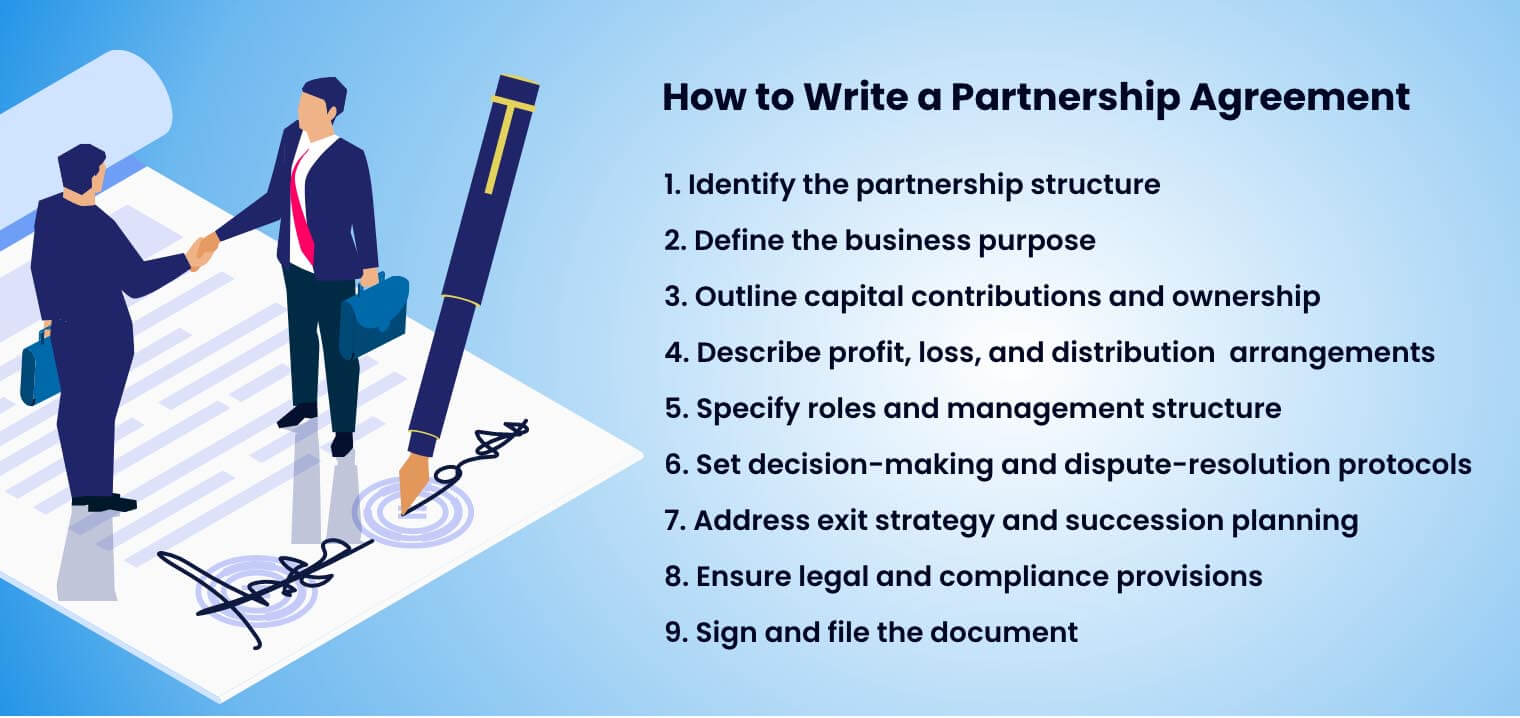
Introduction: The Legal Backbone of Every Successful Partnership
A business partnership can be a powerful growth strategy—but without a well-structured agreement, it can quickly become a source of legal disputes and financial loss. A partnership agreement is a foundational legal document that defines the rights, duties, and responsibilities of each partner, establishing a framework for governance, profit sharing, conflict resolution, and exit planning.
Whether you’re forming a law firm, consulting group, startup, or family business, knowing how to draft an effective partnership agreement is essential for long-term success. This article outlines the essential components, legal implications, and best practices to help you draft clear, enforceable, and future-proof partnership agreements.
1. Define the Type of Partnership Structure
Before drafting begins, clearly determine the type of partnership your business will operate as. Each structure carries different legal and tax implications.
Common Partnership Types:
- General Partnership (GP): All partners share liability and management equally.
- Limited Partnership (LP): Includes general and limited partners; limited partners have liability only up to their investment.
- Limited Liability Partnership (LLP): Partners have limited liability and are not responsible for each other’s misconduct or negligence.
- Limited Liability Limited Partnership (LLLP): A newer form where general partners also enjoy limited liability.
Why it matters: Your partnership type determines how you draft key clauses around liability, management, and contributions.
2. Clearly Identify All Partners
List each partner’s full legal name, address, and any business entity they may represent. This section should also specify the date of formation and whether any initial capital contributions are being made at the outset.
Best Practices:
- Include a clause stating that all parties enter voluntarily and with full understanding.
- Reference any related documents or prior agreements.
- Have all partners sign and date the agreement at the end.
3. Outline Capital Contributions and Ownership Interests
Specify how much each partner is investing in the business—whether in cash, property, intellectual property, or services—and what percentage of ownership interest they hold as a result.
Key Points to Cover:
- Initial contributions: What each partner brings to the table.
- Ongoing contributions: Will additional investments be required?
- Ownership structure: How is equity divided?
- Valuation method: How is each partner’s stake valued in the future?
Tip: Use a detailed table in an annex to break down contributions and equity percentages.
4. Define Profit and Loss Sharing Arrangements
Clearly describe how profits and losses will be distributed among partners. This can be based on ownership percentage or other agreed-upon ratios.
Common Distribution Models:
- Pro rata (based on equity share)
- Equal distribution
- Performance-based allocation
Include provisions on timing of distributions, whether profits are retained in the business, and how tax liabilities are handled among partners.
5. Detail Management and Decision-Making Authority
Clarify who is responsible for day-to-day operations, who has authority to bind the partnership, and how strategic decisions will be made.
Key Areas to Address:
- Management structure: Single managing partner or collective decision-making?
- Voting rights: One vote per partner or based on ownership percentage?
- Approval thresholds: What decisions require unanimous consent vs. majority vote?
- Delegation: Can authority be delegated to employees or committees?
Clearly defining roles reduces misunderstandings and operational bottlenecks.
6. Establish Rules for Partner Withdrawals and Termination
No partnership lasts forever. Set up detailed exit mechanisms to protect all parties if a partner wants to leave, retire, or is removed for cause.
Include Clauses for:
- Voluntary withdrawal: Required notice period, buyout terms, and non-compete obligations.
- Involuntary removal: Misconduct, incompetence, or breach of duty.
- Death or incapacity: Succession plans or estate buyout provisions.
- Buy-sell agreements: How and when a partner’s interest can be sold or transferred.
Why It Matters: Exit disputes are among the most common causes of partnership litigation. Prevention begins with good planning.
7. Include Non-Compete and Confidentiality Provisions
To protect the business from insider competition or IP theft, include restrictive covenants.
Recommended Clauses:
- Non-compete: Prevents partners from starting or joining a competing business for a specified period and region after leaving.
- Non-solicitation: Prevents solicitation of clients, employees, or vendors.
- Confidentiality: Protects proprietary data, strategies, and trade secrets even after departure.
Ensure that these clauses are reasonable and enforceable under applicable state or national laws.
8. Define Dispute Resolution Mechanisms
Despite best intentions, conflicts may arise. Decide in advance how they’ll be handled to avoid costly and disruptive litigation.
Options to Include:
- Internal mediation first
- Arbitration clause
- Venue and jurisdiction selection
- Governing law clause
Including a robust dispute resolution section saves time and money while preserving relationships.
9. Address Tax and Financial Reporting Responsibilities
Partnerships are typically pass-through entities, meaning income is taxed at the partner level. Your agreement should specify how taxes are handled.
Important Tax Considerations:
- Who is the tax matters partner (TMP)?
- How are K-1 forms prepared and distributed?
- Will a CPA be engaged annually?
- How are accounting methods and fiscal years chosen?
Maintain clarity around tax filing obligations, profit allocations, and partner liabilities.
10. Include Miscellaneous Legal Provisions
To ensure enforceability and clarity, include standard legal clauses often found at the end of the agreement.
Standard Provisions to Add:
- Entire agreement clause
- Amendment procedures
- Severability
- Force majeure
- Notice requirements
- Successors and assigns
These sections protect the integrity of the agreement in the event of unforeseen changes or challenges.
11. Use Legal Counsel and Tailor to Jurisdiction
While templates exist, partnership agreements must be customized to your business, goals, and location.
Best Practices:
- Hire a lawyer familiar with partnership and contract law.
- Ensure the agreement complies with state-specific statutes or country-specific regulations.
- Update the agreement periodically as the business grows or laws change.
Legal oversight ensures enforceability and reduces the risk of future disputes.
Conclusion: A Strong Agreement Is a Strong Foundation
Drafting an effective partnership agreement isn’t just a legal formality—it’s a proactive strategy to protect your business and professional relationships. By clearly defining expectations, contributions, governance, and exit strategies, your partnership will have the tools it needs to operate smoothly and resolve conflicts constructively.
Sponsored Link